1955-1958
The Case for a Unified BarIndia's First Law Commission, chaired by M.C. Setalvad, recommends in its 14th Report the creation of a unified, independent national bar. The report provides the intellectual foundation on which the Association will be built.
1959
The Association is FoundedOn 8 August 1959, the Bar Association of India comes into existence. M.C. Setalvad - India's first Attorney-General, the country's pre-eminent jurist, and the principal author of the First Law Commission's vision - becomes Founder President. Dr. K.M. Munshi and Solicitor General C.K. Daphtary stand alongside him as co-founders.
1960
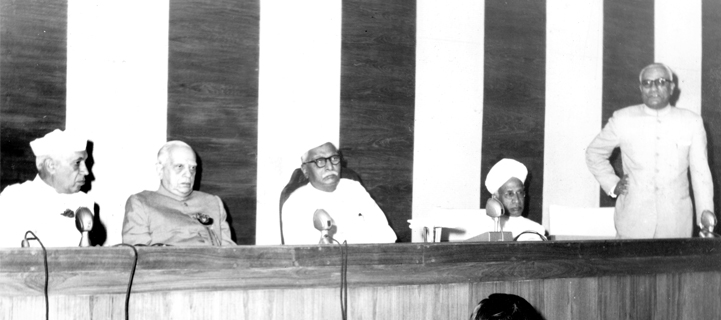
Inauguration, and an Indian Voice at Lincoln's InnOn 2 April 1960, President Rajendra Prasad formally inaugurates the Association at Vigyan Bhavan in the presence of Prime Minister Nehru and the Chief Justice of India. Later that year, Setalvad delivers the Hamlyn Lectures at Lincoln's Inn, London - the first scholar from a non-English-speaking country to receive that honour - speaking on 'The Common Law in India.' Back home, the Association launches a lecture series that brings the ambassadors of the United States, Poland, and Switzerland to address the Indian Bar on their respective constitutional traditions.
1961
The Advocates Act, and a Code of Ethics for the ProfessionThe Advocates Act, 1961 fundamentally reshapes the legal profession, establishing a unified All-India Bar. The Association responds with a landmark Seminar on Professional Ethics in Delhi, out of which emerges a Code of Professional Ethics for Indian lawyers. Two standing committees - on Legal Aid and on the Problems of the Junior Bar - are constituted, marking the beginning of the Association's sustained engagement with access to justice.
1962
A National Law Conference, and Legal Aid for Soldiers' FamiliesWorking with the Indian Law Institute, the Association co-hosts the Third All India Law Conference at Vigyan Bhavan. The conference reconstitutes the Committees on Fundamental Rights and Legal Aid. That same year, with the Ministry of Defence's endorsement, the Association establishes a scheme of free legal aid for the families of defence personnel - one of India's earliest organised pro bono initiatives.
1966
Co-Founding LAWASIAAt a conference in Canberra convened jointly with the Law Council of Australia, the Association helps establish the Law Association for Asia and the Western Pacific - LAWASIA. The first All-India Bar Council Conference is also held at Jaipur. Both events mark the Association's simultaneous deepening of national and international legal architecture.
1968
International Jurists Conference on Freedom of MovementIn the year the United Nations designates as International Human Rights Year, the Association hosts the International Jurists Conference in Bangalore. Delegates from across Asia deliberate on freedom of movement as a fundamental human right, calling for streamlined passport and visa regimes and recommending the creation of a regional human rights body modelled on the Council of Europe.
1971
India Hosts the Commonwealth Law ConferenceNew Delhi plays host to the Fourth Commonwealth and Empire Law Conference - inaugurated by the President of India and attended by approximately 1,000 delegates from across the Commonwealth. It is the most ambitious legal gathering the Association has organised to this point, and it establishes a template for India's role as a convener of international legal dialogue.
1973
Standing Up for the JudiciaryWhen the government supersedes three sitting Supreme Court judges to appoint a Chief Justice of India it finds more amenable, the Association does not stay silent. It passes a resolution condemning the decision as a politically motivated assault on judicial independence - one of the clearest instances of the Association acting as a guardian of constitutional values.
1977
Reclaiming the Rule of Law After the EmergencyIn the immediate aftermath of the Emergency, the Association co-hosts a Lawyers' Symposium at the Calcutta High Court Centenary Building on the supremacy of the rule of law and the independence of the judiciary. The gathering calls for the repeal of repressive legislation, the amendment of Article 22, and the strengthening of judicial review - a forceful reassertion of constitutional norms.
1979
Launching LAWASIA's Human Rights ArchitectureThe Association plays a central role in the inaugural meeting of the LAWASIA Human Rights Standing Committee, helping lay the institutional groundwork for regional human rights advocacy across Asia and the Pacific - a commitment that would deepen considerably in the decades that followed.
1982
The IBA Comes to IndiaNew Delhi hosts the 19th Biennial Conference of the International Bar Association - among the largest international legal gatherings ever held on Indian soil. The event brings together the world's leading legal practitioners and reflects the Association's growing stature as a bridge between the Indian Bar and the global profession.
1985
LAWASIA Returns to New DelhiThe Association hosts the 9th LAWASIA Conference in New Delhi under the theme 'The Role of Law and the Rule of Law: Perspectives in the Mid-Eighties.' Prime Minister Rajiv Gandhi inaugurates the proceedings. More than 400 international delegates participate, making it one of the largest such gatherings in LAWASIA's history at the time.
1991
Indian Leadership at LAWASIA's Silver JubileeAt the 12th LAWASIA Conference in Perth - coinciding with the organisation's Silver Jubilee - a BAI Vice President is elected LAWASIA President for 1991-1993. It is the second time an Indian lawyer has led the regional body, a reflection of the Association's sustained commitment to Asia-Pacific legal cooperation.
1992
Legal Aid as a Human RightThe Association co-hosts an international seminar in New Delhi - 'Legal Aid: A Human Right or a Favour' - bringing together over 125 delegates from across the Asia-Pacific. The Vice President of India inaugurates the proceedings. The seminar's central argument, that legal aid is a right and not a charitable dispensation, would prove influential in subsequent domestic and international discourse.
1993
Mary Robinson Delivers the BAI LectureMary Robinson, President of Ireland and one of the foremost champions of international human rights, delivers the fourth BAI Lecture in New Delhi. Her address draws on the shared constitutional inheritance of Ireland and India - two post-colonial democracies whose founding documents are bound by a common philosophy of rights.
1999
India's Constitution at the Turn of the CenturyThe Association's website is inaugurated by the Chief Justice of India. More significantly, a four-day Constitutional Assembly - 'India's Constitution in the 21st Century' - draws representatives from political parties, minority communities, civil society, and the academy. Its closing resolution is unambiguous: 'The Constitution has not failed us - we, the people of India, have failed the Constitution.'
2000
40th Anniversary; the Indo-French Legal Initiative is BornThe Association marks forty years with a commemorative conference on 'New Dimensions of Law.' It also co-sponsors the inaugural conference of the Indo-French joint legal initiative - a collaboration with the Paris Bar, FICCI, and its French counterpart MEDEF - on legal frameworks for public infrastructure development. The partnership with the Paris Bar, begun here, would endure.
2002
The Peter Gruber Award - a Nobel Prize for LawPresident F.S. Nariman receives the Peter Gruber Foundation Award in Richmond, Virginia - widely regarded as the Nobel Prize of the legal world. The citation honours his lifetime of principled advocacy and his role in binding together a diverse nation through creative jurisprudence. The Association celebrates the recognition as a distinction for the entire Indian Bar.
2004
A President of India Comes to the Supreme CourtFor the first time in the country's history, a sitting President of India attends a formal function at the Supreme Court. Dr. A.P.J. Abdul Kalam delivers the inaugural Nani Palkhivala Memorial Lecture, jointly organised by BAI and the Supreme Court Bar Association - a tribute to one of the finest advocates independent India produced.
2005
The Setalvad Lecture Series on Judicial EthicsThe Association establishes the M.C. Setalvad Memorial Lecture Series on Canons of Judicial Ethics. The inaugural lecture is delivered by the Chief Justice of India. Named after the Association's Founder President, the series reflects a conviction that the ethical conduct of the judiciary is not merely a professional question but a constitutional one.
2007
New Partnerships; a Voice for Pakistan's JudgesA Memorandum of Understanding is signed with the Law Society of England and Wales. President F.S. Nariman receives the Padma Vibhushan. When Pakistan's government summarily suspends its Chief Justice and detains lawyers and judges, the Association speaks out publicly - calling on the SAARC Bar not to attend a conference in Pakistan while the rule of law there remains in abeyance.
2009
Golden Jubilee: Amartya Sen on the Idea of JusticeThe Association's 50th founding year is marked by seminars and celebrations across India. The centrepiece is a Golden Jubilee Lecture by Nobel Laureate Prof. Amartya Sen on 'The Idea of Justice,' inaugurated by the Vice President of India. The year also sees a frank national seminar on rethinking the legal profession and justice delivery system.
2010
Prime Minister Opens the Jubilee Conference; LAWASIA Comes to DelhiPrime Minister Manmohan Singh inaugurates the Golden Jubilee Conference on 'Law and Governance' in New Delhi. The Association also hosts the 23rd LAWASIA Annual Conference, drawing more than 150 international participants. Justice V.R. Krishna Iyer's address at the plenary session receives a standing ovation - a memorable moment in a landmark year.
2013
A Fourth Indian Leads LAWASIAAn Indian representative is unanimously elected President-Elect of LAWASIA at its Singapore conference - the fourth Indian in the organisation's history to rise to its leadership. The election reflects both the Association's decades of investment in regional legal diplomacy and the esteem in which the Indian Bar is held across Asia and the Pacific.
2014
Founding Member of the BRICS Legal ForumThe Association participates as a founding member in the inaugural BRICS Legal Forum in Brasilia, Brazil, signing the Brasilia Declaration alongside the bar associations and law societies of Brazil, Russia, China, and South Africa. The Forum establishes an enduring platform for legal cooperation among the world's major emerging economies.
2015
Hosting POLA in Goa; Challenging NJAC in the Supreme CourtThe Association hosts the 26th POLA Summit in Goa, keynoted by the Chief Justice of India designate. An Indian lawyer becomes the youngest person to assume the Presidency of LAWASIA. Separately, BAI files a writ petition in the Supreme Court challenging the constitutionality of the National Judicial Appointments Commission Act - a direct intervention in the debate over judicial independence and appointments.
2016
The Third BRICS Legal ForumNew Delhi hosts the Third BRICS Legal Forum - the first time India plays host to this gathering of the world's major emerging-economy bars. Mooted the launch of BRICS and Emerging Economies Arbitration Network.
2018
A National Reckoning on Judicial ReformAgainst the backdrop of an unprecedented press conference by four sitting Supreme Court judges, the Association convenes the Rule of Law Convention 2018 on Judicial Reforms - drawing bar leaders from 21 states and union territories. A follow-up All-India Conference is held in Hyderabad. The 6th M.C. Setalvad Memorial Lecture, delivered by the Chief Justice of India, adds a note of institutional reflection to a year of considerable debate about the judiciary's future.
2019
The First LAWASIA Human Rights Conference; a Scholarship for the WorldNew Delhi hosts the inaugural LAWASIA Human Rights Conference, with over 300 participants from across the Asia-Pacific and the Vice President of India as Chief Guest. The sessions range from surveillance and privacy to climate change and press freedom - a reflection of how the Association understands the rule of law in the 21st century. BAI also establishes the BAI-Penn State Law Scholarship, opening a pathway for Indian lawyers to pursue postgraduate legal education in the United States.
2020
Governance Through a Pandemic; the Constitution at SeventyWhen the COVID-19 pandemic makes in-person gatherings impossible, the Association holds its Governing Council elections online for the first time in its history - a signal that institutional life would continue. To mark both the Constitution's 70th anniversary and BAI's own 60th year, the Association publishes a landmark Compendium of nearly fifty articles by former judges, senior counsel, academics, and public figures. The Attorney General of India releases it; the President of India receives the first copy.
2021
Hosting the BRICS Legal Forum; Joining the Global Rule of Law ArchitectureNew Delhi hosts the VIII BRICS Legal Forum. A BAI representative is elected to the Board of Directors of the International Legal Assistance Consortium (ILAC) - only the second Asian to serve on that Board - bringing an Indian voice to the governance of one of the world's foremost rule-of-law capacity-building organisations. BAI also joins the World Bank's Law Societies Compact for SDG16, formalising its commitment to making justice accessible everywhere.
2022
Measuring the Rule of Law; Expanding India's Global Legal PresenceBAI partners with the World Justice Project on the launch of the Rule of Law Index 2022, co-presenting findings that benchmark India and its peers against universal standards of governance and rights. The Association's delegations attend forums in Berlin, Tashkent, and Tokyo, and co-organise the Tokyo Arbitration Event with UNCITRAL and ICSID - deepening India's engagement with international commercial dispute resolution at the highest levels.
2023
Launch of New Delhi International Rule of Law ConventionEstablishing New Delhi as a prominent Global Platform for Rule of Law Conversations